
INTRODUCTION
Rotorless Rheometer DDR2025
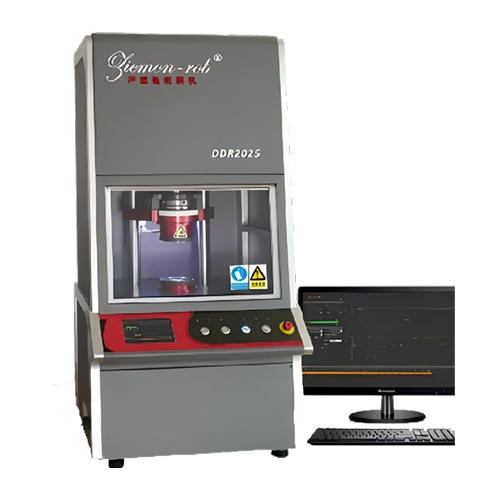
It is an upgraded version of the conventional rotorless rheometer and a quality control-specific variant of the RPA2025 Rubber Process Analyzer. It is specially designed for on-site rapid testing of the processing properties, curing characteristics and viscoelastic properties of raw rubber, unvulcanized rubber, vulcanizable rubber and compound rubber.
By utilizing wide-range variations in oscillation frequency, shear strain and test temperature within a pressurized closed cavity, it can measure in a single run the processing properties of rubber samples before vulcanization, curing characteristics during vulcanization, and physical properties after vulcanization. Its fixed “one-touch” test method complies with international standards such as ASTM D5289 and ASTM D6204.
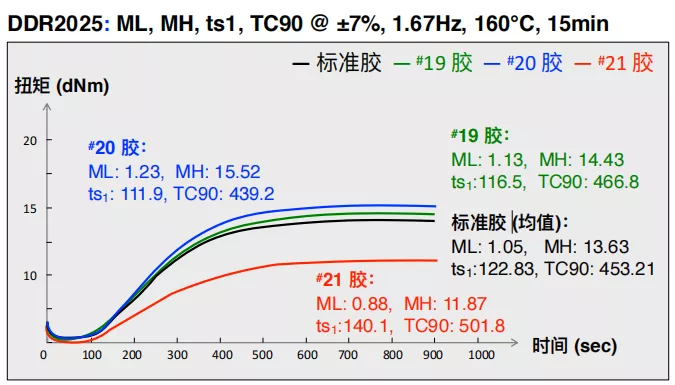
The rubber specimen is placed in a closed cavity at a set temperature. The cavity consists of an upper die and a lower die, in which the lower die is driven by a direct-drive servo motor system to perform small reciprocating rotational oscillations. This generates a sinusoidal torsional strain on the specimen and a sinusoidal torque dependent on the stiffness (shear modulus) of the rubber compound. The variation of the torque envelope, defined as amplitude, over time is recorded. The increase in stiffness of the rubber specimen corresponds to the vulcanization process, and the rise in torque is recorded until it reaches equilibrium or a maximum value within a specified time.
An optional automatic kit is available for high-volume rubber sample testing. The testing process is highly automated: the operator only needs to place the specimens on the tray, and the robotic arm automatically loads the samples to be tested, performs tests automatically in accordance with the set test methods, and unloads the samples automatically after testing. This meets the user’s requirements for improving testing efficiency, reducing labor intensity, saving production costs, and eliminating human errors.
1. Drive System
The analyzer adopts a direct-drive servo motor system rigidly connected to the lower mold cavity, which eliminates data deviations caused by cumulative errors, deformation and wear inherent in conventional drive structures consisting of motors, cam eccentric mechanisms, connecting rods and gearboxes. This design greatly improves the accuracy of oscillation frequency and oscillation angle (shear strain), with a data repeatability difference coefficient ≤ 3%. Equipped with independent high-strength wear-resistant bearings, it effectively resists local bearing wear, greatly prolongs the service life of bearings, and enables easy disassembly and assembly with low maintenance costs.
2. Temperature Control System
Adopting DC heating and PID temperature control technology coupled with high-grade 4-wire platinum resistance temperature measurement, the system features small temperature fluctuation and fast response. The heating rate is no less than 1ºC/s, the cooling rate is no less than 0.6ºC/s, the temperature control accuracy is within ±0.2ºC, the temperature recovery time is less than 30 seconds, and the overshoot is less than 0.3ºC.
3. Torque Measurement System
Equipped with a high-grade torque sensor with an accuracy of ±0.01dNm, the system features high sensitivity to detect subtle changes in rubber compounds accurately.
4. Real-Time Monitoring System
A 7-inch color LCD screen is adopted to monitor the test process in real time and display test data and equipment status, including temperature, torque, frequency, data points, error prompts and fault alarms.
5. Torque Calibration
A compression-type torque calibrator is used for torque recalibration, which is convenient and efficient, eliminating cumbersome installation procedures.
6. System Software
The independently developed Zimeng quality control dedicated software features an intuitive human-machine interface, real-time data and curve display, control standard establishment, and optional barcode input function. It enables centralized data management, storage and transmission.
7. Functional Expansion Options
- Pressure Kit: Allows simultaneous testing of vulcanization characteristics and pressure changes of foamed rubber;
- Automatic Test Kit: Realizes fully automated single-machine testing for high-volume sample detection;
- Barcode Input Kit: Enables quick and easy entry of rubber compound information to facilitate intelligent and informatized testing.
8. Customizable Data Points
Users can select data points according to actual demands to test the comprehensive characteristics of rubber compounds, including:
| Category | Subcategory | Parameter Type | Symbols |
|---|---|---|---|
| Torque and Curve | Elastic Torque (S’) | Torque Value | ML, MH |
| Viscous Torque (S”) | Scorch Time | ts₁, ts₂ | |
| Loss Tangent (tanDelta) | Cure Time | TC10, TC50, TC90, RTT97 |
9. Network Connectivity
Supports TCP/IP protocol for stable data transmission and management, facilitating centralized data collection, storage, processing and transmission.
Standard Vulcanization Test
Under the preset shear strain of ±7% (lower cavity oscillation arc angle ±0.5°) or ±14% (lower cavity oscillation arc angle ±1.0°), oscillation frequency of 1.67Hz and isothermal vulcanizable conditions, the changes of rubber compound torque (S’, S”) and hysteresis loss (tanδ) over time are tested. The vulcanization characteristics at a specific shear rate of 0.73 s⁻¹ are obtained in a single test, in compliance with international standards such as ASTM D5289.
| Item | Specification | Item | Specification |
|---|---|---|---|
| International Standard | ASTM D5289, etc. | Torque Measurement | Torque sensor, mounted on the upper cavity |
| Test Cavity | Sealed double-conical cavity | Cavity Gap | 0.45mm ±0.05mm (adjustable) |
| Cavity Closing Force | ≥ 8.0kN | Oscillation Frequency | 1.67Hz ±0.1Hz |
| Oscillation Angle (computer-set) | ±0.5°±0.03° or ±1.0°±0.03° | Shear Strain (computer-set) | ±7%±0.42% or ±14%±0.42% |
| Torque Range | 0.01~200.00 dNm (accuracy: 0.5% of reading) | Sample Volume | ≈ 4.5cm³ (sample compound must fill the cavity completely) |
| Temperature Control Range | Room temperature ~ 200.00°C ±0.3°C | Temperature Detection | 4-PT100 |
| Drive System | Servo direct drive | Test Method | Vulcanization test |
| Measurement Units | Torque: dNm, in-lb, kg-cm | Air Supply Requirement | ≥ 0.6MPa clean air |
| Temperature: °C, °F; Frequency: Hz, cpm | Power Supply Requirement | 220 V±5%, 50Hz, 10A single-phase, well-grounded | |
| Time: min or sec | Package Dimensions | L: 80cm, W: 80cm, H: 165cm | |
| Pressure: bar, kg/cm³ (optional) | Weight | Gross: 255kg, Net: 230kg |