
INTRODUCTION
Mooney Viscometer DNMV2025
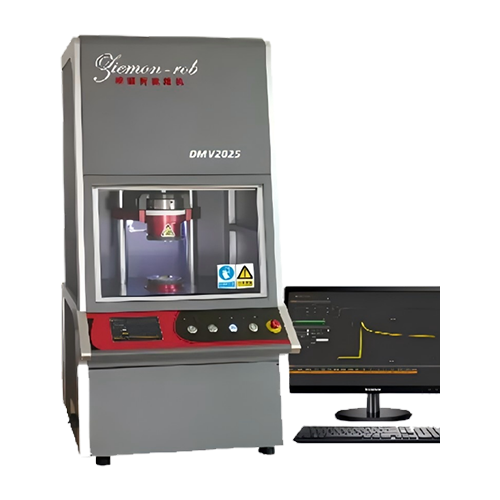
The Mooney Viscometer DNMV2025 is a specialized instrument designed to evaluate the processability of rubber raw materials and compounds, which is related to their average molecular weight and plasticity.
Compared with traditional Mooney viscometers operating at a rotor speed of 2 rpm, the DMV2025 features a rotor speed range of 0.1 to 30 rpm. This allows it to simulate the actual processing conditions of rubber under various shear rates, enabling in-depth analysis and research on the processing characteristics of rubber compounds and the differences in processability among different formulations.
The standard Mooney viscosity test method complies with ASTM D1646.
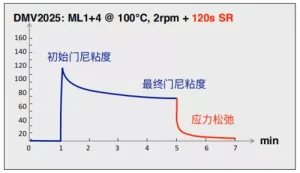
At a specified temperature, a rigid disc rotor embedded in the rubber compound rotates slowly and continuously in one direction within a cylindrical mold cavity for a prescribed duration. The resistance exerted by the sample on the rotor is measured as torque in units of “Mooney viscosity”.
At the conclusion of the Mooney viscosity test, the rotor stops instantaneously, and the change in torque decay over time is measured, which is referred to as “stress relaxation”. The viscoelastic properties of the rubber compound govern this relaxation process.
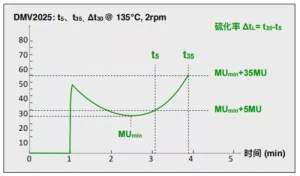
The Mooney viscosity of a vulcanizable rubber compound is determined under a specified heating temperature. The minimum viscosity value and the time taken for the viscosity to rise to a specified level are defined as the “scorch time” (onset of vulcanization), and the difference between these values represents the rate of vulcanization.
1. Drive System
Equipped with a servo direct-drive motor system to directly drive rotor rotation. The rotor speed can be set arbitrarily within 0.1~30.0 rpm with a precision of 0.01 rpm. The direct-drive Mooney viscometer DMV2025 eliminates data deviations caused by mechanical accumulated error, deformation and wear in traditional structures such as motors, gearboxes and even belt drives, thus improving data repeatability and reproducibility.
2. Temperature Control System
Adopts DC heating and PID temperature measurement technology, equipped with high-grade 4-wire PT100 platinum resistance. Temperature precision is ±0.1 ºC, heating rate is 1 ºC/s, and temperature overshoot is less than 0.3 ºC.
3. Torque Sensor
Aerospace-grade with a precision of ±0.01, whose high sensitivity enables detection of subtle differences in rubber compounds.
4. Real-Time Monitoring System
Fitted with a 7-inch LCD touch screen to display and monitor the test process and equipment status in real time, including real-time temperature, Mooney viscosity, time, rotor type, error messages and fault alarms.
5. Calibration
One-key automatic weight calibration and automatic balancing.
6. System Removal
The rotor automatically ejects upon test completion, making operation easy and sample cleaning convenient.
7. System Software
Self-developed Zimeng Quality Inspection software features an intuitive human-machine interface, real-time data and curve display, customizable control standards, optional barcode input, and enables centralized data management, storage and transmission.
8. Data Points
Users can select data points according to actual requirements to characterize the properties of rubber compounds.
1, Standard Mooney Viscosity Test (in compliance with international standards such as ASTM D1646)Set the processing temperature, preheating time and test duration. Select the test method for Mooney viscosity (with optional stress relaxation) or Mooney scorch time. After defining the required data points, test data and curves including Mooney viscosity or scorch time of the rubber compound can be measured.
2, The DMV2025 Mooney Viscometer can also perform Mooney viscosity tests at variable shear rates, i.e., with the rotor speed adjustable arbitrarily from 0.1 to 30.0 rpm, to evaluate the processability of rubber compounds related to their average molecular weight or plasticity. Generally, the plasticity of rubber compounds decreases (viscosity increases) with rising shear rate. However, the degree of plasticity reduction varies with different compound properties, resulting in different processing performance of compounds with the same or similar Mooney viscosity values.
Conventional Mooney scorch time is usually tested at a low shear rate and regarded as the safe processing time of the compound, yet it cannot reflect the shear heat generation in actual processing. Consequently, the actual Mooney scorch time shortens significantly with increasing shear rate. By measuring Mooney scorch time at various shear rates, the behavior of rubber compounds under real processing conditions can be accurately simulated.
| Item | Specification |
|---|---|
| Test Standard | Conforms to ASTM D1646 and other international standards |
| Rotor Speed | 0.1 ~ 30 ±0.01 rpm; Standard speed: 2.0 rpm |
| Sample Volume | Total 25±3 cm³ for upper and lower test pieces |
| Temperature Control Range | Room temperature ~ 200.00 ºC ±0.1 ºC;Overshoot ≤ 0.4 ºC of set point;Heating rate: 1 ºC/sec |
| Mooney Measuring Range | Large rotor: 0 ~ 200.00 ±0.01 MU;Small rotor: >200.00 ±0.01 MU |
| Test & Data | |
| Mooney Viscosity | Initial Mooney (InitMU), Final Mooney (FinalMU), preheating time and test time |
| Scorch Time | Minimum Mooney viscosity (minMU);Large rotor: t5, t35, Δt30;Small rotor: t3, t18, Δt15 |
| Stress Relaxation | Time to relax X%, Mooney viscosity at x seconds relaxation, slope & intercept, correlation coefficient r |
| Balance Calibration | Auto balance, auto calibration |
| Data Processing System | PC microprocessor system |
| Air & Power Supply | Clean air ≥ 0.38 MPa;220 V±5%, 50 Hz, 10 A single phase |
| Package Dimensions | 80 × 80 × 165 cm |
| Weight | Gross weight: 260 kg;Net weight: 240 kg |