
INTRODUCTION
Rubber Processing Analyzer QC Floor Type RPA2025QC
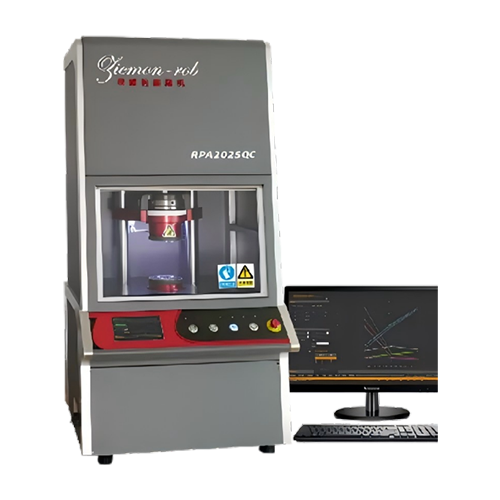
The Rubber Processing Analyzer QC Floor Type RPA2025QC is developed on the basis of conventional rotorless rheometers, incorporating the rubber rheological property test methods specified in ASTM D6204. It is specially designed for on-site rapid quality testing of rheological and curing properties of raw rubber, unvulcanized rubber, compounded rubber, vulcanizable rubber and other thermosetting materials.
Unlike conventional rotorless rheometers or curemeters with fixed oscillation frequency and shear strain, the RPA2025QC adopts a pressurized closed mold cavity with wide adjustable ranges of oscillation frequency, shear strain and test temperature. It can simultaneously measure the dynamic processing properties before curing, curing characteristics and physical properties after curing of rubber samples in a single test.
Its test methods comply with international standards including ASTM D5289 and ASTM D6204. As a quality inspection tool for rheological properties of polymer materials, it is widely used for production and processing quality control in tires, rubber products, raw materials and other related industries, and can replace or upgrade traditional rheological / curing testing methods.
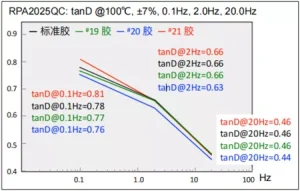
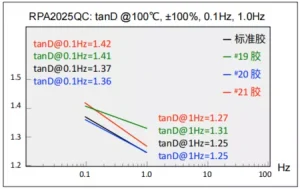
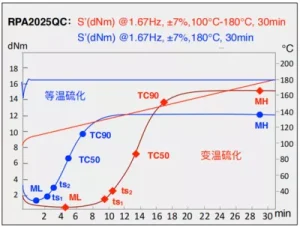
The rubber specimen is placed in a sealed cavity at a set temperature. The cavity consists of an upper mold and a lower mold.
A direct-drive motor system drives the lower mold to oscillate reciprocally, with its oscillation frequency or shear strain variable within a preset range, equivalent to applying a sinusoidal strain of varying frequency or amplitude to the specimen.
A torque sensor mounted on the upper mold measures the specimen’s response to the sinusoidal strain, thereby obtaining the rheological properties and their differences of the specimen at different shear rates, enabling prediction of the final product quality.
1. Drive System
- Direct-drive servo motor drives lower mold to reciprocate; oscillation frequency: 0.1Hz–20Hz (continuously adjustable)
- Shear strain: ±7%–±100% (oscillation arc: ±0.5°–±7.16°, continuously adjustable)
- Independent high-strength wear-resistant bearings, effectively avoiding local wear, prolonging service life; easy assembly, disassembly and low maintenance cost
- Data repeatability difference coefficient ≤ 3%
2. Mold Cavity System
- Rotor-free pressurized closed biconical cavity, compliant with ASTM standards
- Direct heating and air-blast cooling for upper and lower molds, precise temperature control
- Built-in standard test methods of ASTM D6204: small-strain 3-point frequency sweep (ASTM D6204A), large-strain 2-point frequency sweep (ASTM D6204B) and temperature-ramp curing (ASTM D6204C), suitable for rapid on-site quality inspection
3. Temperature Control System
- DC heating with PID temperature control, equipped with high-grade 4-wire platinum resistance sensor
- Heating rate: ≥1°C/s; Cooling rate: ≥0.6°C/s
- Temperature control accuracy: ±0.2°C; Temperature recovery time: <30s; Temperature overshoot: <0.3°C
4. Torque Measurement System
- High-precision aerospace-grade torque sensor, accuracy: ±0.01dNm
- High sensitivity to detect subtle changes in polymer materials
5. Operation & Monitoring
- LCD touch screen, real-time display and monitoring of test data and process: temperature, torque, frequency, error prompts and fault alarms
- Compression-type torque calibrator for quick and easy torque recalibration, no complicated installation required
- Equipped with safety guard and multiple safety detection devices, anti-pinch design to ensure operator safety
6. Optional Expansion Functions
- Pressure kit: simultaneous testing of foamed rubber curing characteristics and pressure changes
- Automatic test kit: automated single-machine testing for RPA2025QC
- Barcode input kit: fast rubber material information entry, realizing intelligent inspection
- WLAN module (optional): supports TCP/IP protocol, wired and wireless data transmission; multi-instrument networking for centralized data management
7. Test Items & Parameters
| Item | Parameter | Unit |
|---|---|---|
| Torque | Complex Torque (S*), Elastic Torque (S’), Viscous Torque (S”) | dNm |
| Shear Modulus | Complex Modulus (G*), Storage Modulus (G’), Loss Modulus (G”) | kPa |
| Hysteresis Loss | tanDelta | – |
| Dynamic Viscosity | Complex Dynamic Viscosity (ŋ*), Real Dynamic Viscosity (ŋ’) | Pa·s |
| Pressure (Optional) | Elastic Torque (S’), Pressure (P) | – |
8. Special Software for Quality Inspection
Self-developed Zimeng special software for rubber testing, with intuitive human-machine interface, supporting real-time data and curve display, standard setup and barcode input, for centralized data management, storage and transmission. Main functions:
- Queue Management: Batch test queue setup for improved work efficiencyPressure kit: simultaneous testing of foamed rubber curing characteristics and pressure changes
- Material Management: Add, edit and delete rubber material information
- Test Method Management: Set various test conditions, select target data points flexibly
- Equipment Control: Download test parameters (temperature, time, etc.) to connected instruments directly
- Data Acquisition: 60–300 data points per minute, recording full dynamic test data
- Standard Management: Set control standards for data points, auto-judge test pass/fail results
- Report Generation: Generate single test reports, summary reports and test curves; customizable report formats
- Multi-machine Connection: One workstation connects multiple instruments simultaneously
- Distributed Application: Networked workstations with centralized server data storage and unified management
- Data Export: Export data in XML, TXT, XLSX and other formats for further analysis
- Authority Management: Assign operation rights for operators and administrators
- Queue Management: Batch test queue setup for improved work efficiency
- In addition to the isothermal cure test specified in ASTM D5289, the curing characteristics of rubber compounds can also be measured under linear temperature ramp conditions, which improves scorch sensitivity, simulates actual production conditions, and provides a basis for studying the curing behavior of thick rubber products.
- The small-strain three-point frequency sweep is used to determine the processability differences of raw rubber caused by variations in branching structure, average molecular weight and molecular weight distribution; it also evaluates the processability differences of mixed rubber resulting from flow properties, shear thinning and die swell variations.
- The large-strain two-point frequency sweep is used to determine the processability differences of raw rubber caused by variations in gel content; it also evaluates the processability differences of mixed rubber resulting from viscosity at high shear rates and die swell variations.
Small-strain three-point frequency sweep, large-strain two-point frequency sweep and linear temperature ramp cure test can be combined arbitrarily. After completing the frequency sweep test at processing temperature, the test can smoothly transition to curing temperature, enabling one-step measurement of both processability and curing characteristics of the rubber sample.
| Item | Specification |
|---|---|
| International Standards | ASTM D5289, ASTM D6204 |
| Torque Range | 0.01 ~ 200.00 dNm |
| Test Methods | Standard Cure TestSmall-Strain Frequency SweepLarge-Strain Frequency SweepLinear Temperature Ramp Cure |
| Units of Measurement | Torque: dNm, in-lb, kg‑cmModulus: Pa, dynes/cm², psiDynamic Viscosity: Pa·sTemperature: °C, °FTime: min‑min / min‑secFrequency: Hz, cpm |
| Test Cavity | Sealed Biconical Cavity |
| Sample Volume | ≈ 4.5 cm³ |
| Cavity Gap | 0.45 ± 0.05 mm (adjustable) |
| Cavity Closing Force | ≥ 11.5 kN |
| Motor Drive | Servo Direct Drive |
| Motor Encoder | Indexing accuracy: 5000 linesResolution: 0.018° |
| Oscillation Frequency | 0.1 ~ 20 Hz |
| Torque Calibration | Compression Type Torque Calibration |
| Oscillation Arc | ±0.5° ~ ±7.16° |
| Temperature Sensor | 4‑wire PT100 Platinum Resistance |
| Shear Strain | ±7% ~ ±100% |
| Heating Method | DC Heating |
| Temperature Control Range | Ambient ~ 200.00 °C ± 0.2 °C |
| Air & Power Requirements | Clean compressed air ≥ 0.6 MPa220V ±10%, 50Hz, 10A, single‑phase |